What usually sets the cut height
| Situation | Typical approach | Reason |
|---|---|---|
| Clean water, caught quickly, no insulation in the wall | Sometimes no cut; drill small holes and dry the cavity | Drywall can dry if it was wet briefly and the cavity can be ventilated |
| Clean water with fiberglass insulation behind | Cut above the wet line so the insulation can come out | Wet insulation holds water against framing and won't dry in place |
| Groundwater seepage | Cut a bit above the highest wicking reading | Outside water carries soil and organic material |
| Sewage from a floor drain | Cut well above the visible water line | Contaminated water wicks up the paper and gypsum |
| Water sat for several days | Higher cuts, often to a full sheet height in places | Wicking and mold growth extend farther with time |
Why a straight line instead of just the stained part
Drywall soaks water up like a paper towel. The visible stain is usually lower than the true wet line, because moisture keeps climbing for hours after the floor is dry. A moisture meter run up the wall every few inches shows where readings return to normal, and the cut goes somewhat above that.
Cutting at a consistent height also makes the rebuild cleaner. A drywall installer can hang new strips along the bottom of every affected wall, tape one seam, and finish it so it disappears. Ragged patches cut around stains take longer to finish and are harder to dry behind.
In many finished basements in older Englewood homes, the walls are not standard. Some have furring strips nailed straight to the concrete with thin paneling over them. Others have framed walls with old batt insulation, a plastic vapor sheet stapled behind it, or nothing at all. Each of these traps water differently, so the first cut often doubles as an inspection hole.
What happens once the wall is open
Remove wet insulation
Fiberglass batts that got wet are bagged and removed. They rarely dry fully in a closed wall.
Check the bottom plate
The horizontal board at the base of the wall sits closest to the water. Readings and a screwdriver test show whether it is just wet or soft.
Look at the concrete
With the wall open you can see cracks, efflorescence and the cove joint, which helps confirm where groundwater came in.
Dry the cavity and slab
Air movers aimed into the open cavity and a dehumidifier in the closed room bring framing and concrete down to normal readings.
Rebuild only when dry
New drywall goes up after readings in framing and concrete reach a dry standard. Closing the wall early traps moisture and invites mold.
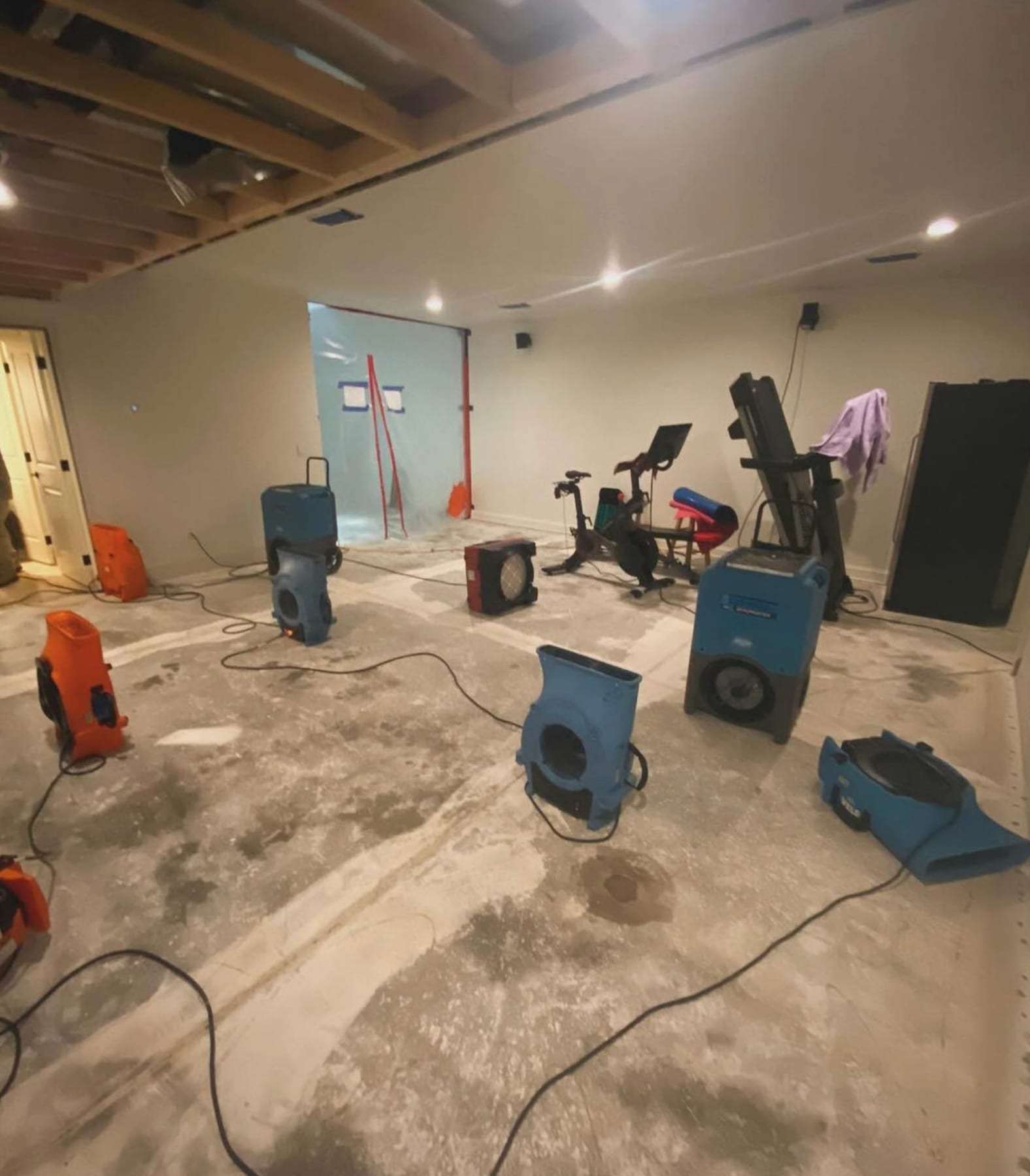
Basement drying with air movers and dehumidifiers. A representative photo of the task, not a record of work at any particular property.
General information for Englewood, not a quote or professional advice. In an emergency, call 911.