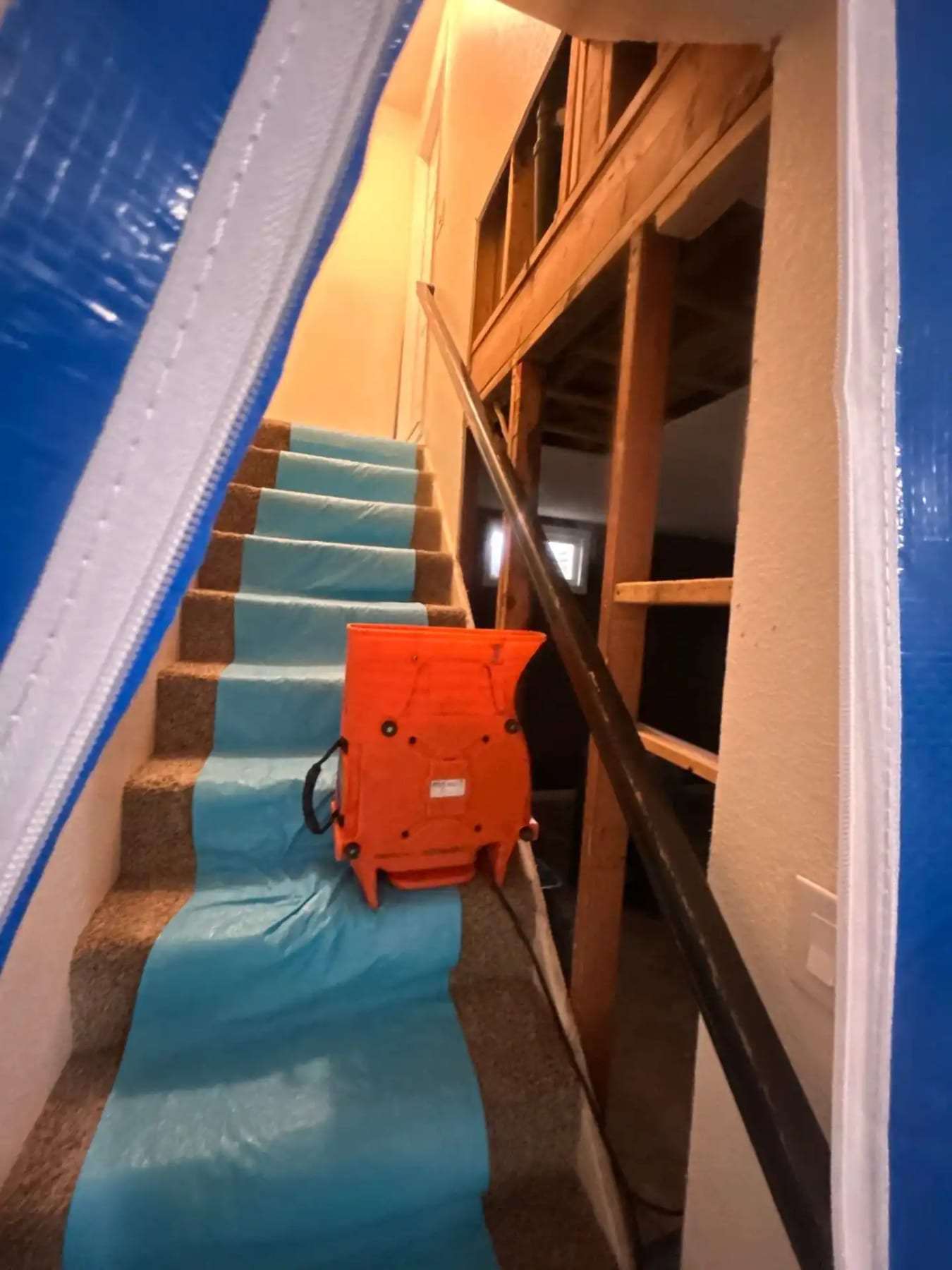
Carpeted staircase wrapped in plastic with an air mover on the steps. Illustrative only: this photo is not from a job tied to this site or a specific address.
Why stairwells flood
An exterior basement stairwell, sometimes called an areaway, is an open pit beside the house. Every drop of rain that falls into it, plus anything that runs off the surrounding yard or roof, ends up at the landing in front of the basement door. A drain in the landing is supposed to carry that water away, usually into the footing drain, a sump or, in some older homes, the sanitary sewer.
These drains are small, sit at the bottom of a pit where leaves and grit collect, and are easy to forget. When one clogs, the landing fills like a bathtub. Once water rises above the door threshold, it pours under the door and across the basement floor. Because the stairwell has walls on three sides, it can fill surprisingly fast in a summer cloudburst.
If the stairwell drain connects to the sanitary sewer, there is a second issue: a sewer backup can push water up out of that drain and into the stairwell instead. Many cities discourage or prohibit connecting storm water to sanitary sewers, so if yours does, ask a plumber what the options are.
Clearing and testing the drain
Remove debris
Lift out leaves, mulch and grit from the landing and the drain grate. Wear gloves; there may be broken glass or sharp debris.
Flush with a hose
Run a garden hose into the drain for several minutes. Water should disappear without pooling.
Watch for slow draining
If water backs up, a plumber can snake the line and run a camera to see where it goes and whether it is broken or root-filled.
Find the outlet
Learn where the drain empties. If it goes to a sump, make sure the sump pump handles it; if it goes to daylight, keep the outlet clear.
Other ways to keep the stairwell dry
General information for Englewood, not a quote or professional advice. In an emergency, call 911.